Tag Archives: #subconscious
A round of golf is a simple “slice of life” where seeds are planted to bear life and golf fruits at future times and places. To grow these fruits of consciousness the only assignment is openness. And, for this student of golf and life, the experience has been that simple is good! And simpler is even better!! Today, the game is about 1) set-up—grip, aim, stance, posture [shoulders high and back, bend forward from the hips, keeping the back straight] and ball position; 2) takeaway—when the club shaft is parallel to the ground the clubhead is in line with the hands; and 3) impact. Let us take a quick journey to impact.
In 2015 it was a pleasure to work with Mike Kahn, a golf course consultant from Florida. Mike had been hired by the community’s golf course feasibility committee to offer input to the challenge of deciding whether to purchase the community’s 27-hole golf course. Having maintained a friendship with Mike, recent email exchanges about golf lessons led him to request a video of the golf swing. His feedback about the swing video came with 1) a seven point impact checklist; 2) descriptive, yellow lines on front and down the line pictures detailing the checkpoints of the swing at impact; and 3) a picture of Tiger Woods at impact. These checkpoints have become quite useful during practice and play that program the trusted subconscious mind to deliver a clubface to the golf ball at impact. Checkpoints at IMPACT are as follows:
- Head behind the ball.
- Knees and elbows toward each other.
- Right heel off the ground: show the cleats on the heel and sole pushing hard off the ground and turning aggressively into the lead hip while keeping the upper body down through the shot.
- Right shoulder tilted below left shoulder 49 degrees, like water draining from the right ear.
- Left leg resistance.
- Left foot on outside edge: show the cleats.
- Right knee is bending—driving—forward through the shot toward the left knee.
For this golfer, the toughest checkpoint has been the 49 degree, right shoulder tilt at impact. A practice routine that has really helped feel the tilt and extension at impact is working in the garage with a Momentus Swing Trainer. Using the Trainer, playing golf and working with GOLFTEC assigned drills the number of weekly swings approaches 1000. Hello subconscious mind! Hope you are feeling and learning!! And the golf is the “bestest” and “funest” ever! Perhaps the impact checkpoints will work for you! Trust the subconscious to swing the club and have fun!! As Jordan Spieth advises, “The most valuable advice of all is to ‘play like a kid.’ Just freewheel it and have fun. I tell myself to just keep my head down and focus on why I love the game.”
Trusting the subconscious mind to swing the golf club has evolved an inspiration to be more positive; and guess what! The game is the “funest” and “bestest” ever!! Placing rampant swing thoughts on a bus to South America, providing clear “desired results” to the subconscious and passionately connecting the conscious mind with the subconscious mind—mind”full”ness—is a new, exciting experience.
Christian D. Larson offers,
The subconscious not only reproduces exactly what has been recorded, but will also form, create, develop and express what mind may desire when the impression is being made; that is, the subconscious not only produces the seed itself, but as many more seeds as the original seed desired to reproduce, and also the exact degree of improvement in quality that was latent in the desire of the original seed or impression.
Essential transitions associated with Coronavirus have triggered inspiring experiences about remaining “golf ready” at home: Momentus Swing Trainer, a stationary bike, Yoga for Golfers (Katherine Roberts, 2004, McGraw-Hill), push-ups, sit-ups, lunges and squats. Last week, while lunging past the living room bookshelves, Cindy Reid’s book, Get Yourself in Golf Shape: Year-Round Drills to Build a Strong Flexible Swing (2005, Rodale), hooked the attention. Her book offers that there are seven positions of the golf swing: set-up, take-away, top of the back swing, initial forward swing, impact, extension and finish; and she offers exercises to train the muscles associated with each position. Could her position exercises be used to link the conscious mind with the subconscious mind?
Working with the subconscious mind is a new experience for this golfer; and I make absolutely no claim to be a subconscious mind expert. A commitment is to keep you informed about progress experiences. As a point of departure, have added Reid’s “impact position” exercises to the home workout routine:
- Wrist club lift
- Wrist roll
- Wrist curl
- Wrist rotation
- Sit-ups and crunches
- Weighted driver
- Cable pull
- Leg curl
Simply trust the programmed subconscious to perform: with passion burning, the captain of the ship squeezes the auto-pilot button and trusts the carefully programmed subconscious to creatively deliver a ball to an intended target. Tiger Woods commented, “I have learned to trust the subconscious, and my instincts have never lied to me.” Joan King offers, “When you are playing at your peak levels, you are trusting your game to your subconscious mind and allowing your swing to happen automatically.” Just train it and let it do its thing!

Ever since teeing up that first golf ball with Mom and Dad at the age of seven, golf has been a patient life coach; and as the years have sped by, the sport continues to coach and counsel. Recent experiences have offered that if open and psychologically ready for the infinite messages, “simple” in golf and life can be discovered beyond sport and life’s complexities.
As humans, Christian Larson’s (The Great Within) message is clear: we are reflections—thinking, personality and character—of the language we live-in. As Abel Leighton Allen contends, “Our todays are the result of our past thinking, our tomorrows the result of our present thinking. We have been our mental parents, and we shall be our own mental children.” How would Woody and Birdy Ball, Golf as Guru, use this taste of philosophy on every shot or putting stroke on the golf course? “Too complicated for us: Just learn to program and trust the subconscious to hit the #$@% golf ball to an intended target.”
Step One: Create a clear, conscious vision of the ball at the desired target; and feel what is required to place the ball at the target: body mechanics, club mechanics, swing motion and ball position.
-Club required.
-Immaculate set-up.
-One piece take-away.
-No hurry to transition for full torque turn.
-Smooth transition.
-Accelerating forward swing and release.
-Club face square to ball-target line at impact.
-Extension of club to target.
-Complete finish.
Step Two: Go to the breath and program the subconscious with the vision of the what and the how—breathe it, think it, deeply feel it, see it, taste it, smell it and touch it.
Step three: Proceed with the pre-shot routine and ritual for the desired shot or stroke.
Step four: Celebrate!
As Birdy offers, “Yes! We are thinking, personality and character reflections of the language we live in. Let’s live in the language we desire! Not the swing thoughts and whims of the monkey mind that keep us mired two shots from insanity.”

The mind is a remarkable gift; however, a single, errant golf ball in the pond on the right of the fairway can rapidly orchestrate a disruptive, conscious mind ramble of swing thoughts. As Voltaire reminds, “The perfect is the enemy of the good.” Perhaps trusting the subconscious mind can enable us to avoid two errant shots from insanity. Let’s peek at a recent journey into the subconscious mind and the opening of a new area for awareness: the part of our mind where 90% of life’s experiences reside.
Interest in the subconscious was inspired by a frustrating journey of “rightitus and pullitius.” The trek started with the coach: we uncovered 32 symptoms that were practiced and taken to the course; and the push right, pull left continued. After reflection and study of literature, a conclusion was that perhaps the root cause was “timing” that was not allowing the clubface to arrive square to the ball-target line at impact. Sounded simple!
Study quickly revealed that timing was a process: synchronous, one piece take-away; back swing to transition (unhurried, 45-degree hip turn; 90-degree shoulder turn; shoulder tilt); smooth transition; accelerating forward swing launched with left hip and knee turn and unwinding upper torso; followed by arms, wrists and hands gripping the golf club arriving with a clubface square to the ball-target line at impact; hands pointing to the intended target. Not an easy fix! Even attempted writing a song to facilitate smoothness, rhythm, timing and tempo.
Enter the concept of trust the subconscious to perform: with passion burning, the captain of the ship squeezes the auto-pilot button and trusts the carefully programmed subconscious to creatively deliver a ball to an intended target. Tiger Woods commented, “I have learned to trust the subconscious, and my instincts have never lied to me.” Joan King offers, “When you are playing at your peak levels, you are trusting your game to your subconscious mind and allowing your swing to happen automatically.”
Perhaps there was nothing wrong with the swing except that the conscious mind “thought” there is something wrong. The “ah-ha:” thinking about mechanics results in jerky, inconsistent, off-balance, out-of-tempo, and off-line shots; and If pieces of the swing are practiced, the on-the course result is pieces of the swing. What pre-shot routine and ritual are working?
- SMILE!! DEEP BREATHING!!
- MASTER of MIND”FULL”NESS MANTRA: inherent in essence is the power-conscious mind, subconscious mind and superconscious mind-to manifest a desired result through the personality and character.
- Select club.
- See and deeply feel ball at target.
- Feel initial hip turn; width of arc; release from transition; clubface square to ball-target line at impact through release, extension and finish (right heel showing).
- Deeply feel trust of subconscious to manifest the desired result.
- Immaculate set-up.
- Be mindful; relaxed focus; pull trigger.
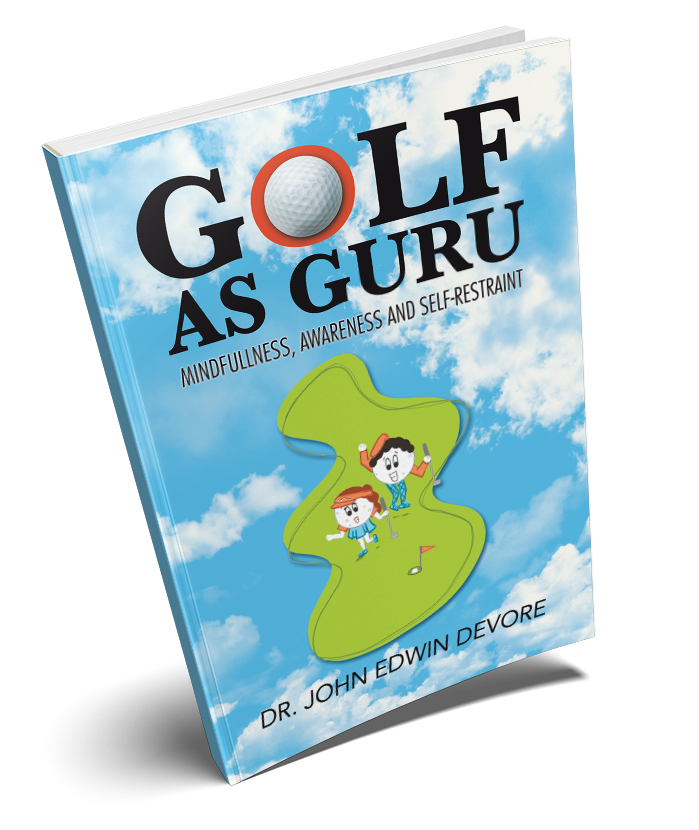
- CELEBRATE! And remember to check Xlibris.com for newly released Golf as Guru: Mindfullness, Awareness and Self-Restraint. You will be pleased to meet Woody and Birdy Ball.
Some subconscious literature sources:
- Allen, D. (2017). The Secrets, Mysteries and Powers of the Subconscious Mind.
- Bargh, J. (2017). Before You Know It: The Unconscious Reasons We Do What We Do. New York, NY: Simon & Schuster.
- Fried, K. (2019). Subconscious Power: Use Your Inner Mind to Create the Life You’ve Always Wanted. New York, NY: Simon & Schuster.
- Hill, N. (2019). Think and Grow Rich: The Secret To Wealth For The 21st Century. DeMarque. Amazon Whispernet.
- King, J. (2017). The Heart of Golf: Access Your Supreme Intelligence for Peak Performances. Amazon Whispernet.
- Murphy, J. (2019). The Power of Your Subconscious Mind. DeMarque. Amazon Whispernet.
- Sternberg, E. (2016). NeuroLogic: The Brain’s Hidden Rationale Behind Our Irrational Behavior. New York, NY: Random House.